by Mark Lewis Taylor,
Remarks Prepared for Panel Presentation,
Sponsored by Churches for Middle East Peace (CMEP)
Nassau Presbyterian Church, Princeton, NJ, May 3, 2026
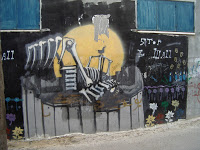
(photo at right, IDF bulldozer walled-in & decaying. Art in Dheisheh Refugee camp, Palestine. By Mark Taylor, Nov. 2007.)
I first came into the U.S. struggle for Palestine in perhaps a peculiar way. I was a professor supervising our Princeton theology students in Guatemala in 1987. There, on a hot dusty day in the capital city, a new police jeep barked out orders over a jarring loudspeaker. I was startled: “What’s that?” My Guatemalan companion said, “Oh that’s part of the latest inflow of military, police and surveillance personnel from Israel to Guatemala’s military junta. As I looked more into Israel’s relation to Guatemala over the years, I became aware that Israel and the U.S. were partners in the genocide against the Maya peoples of Guatemala, with Israel offering military and police aid, weapons, and personnel training. Israel drew from decades of experimentation during its occupation and dispossession of Palestine. In fact, in Guatemala one military officer referred to the outcome of genocide in Guatemala with Israel’s help, as “Palestinization.” I’ve written and documented this in an article published in several venues, entitled “Israel and Genocide: Not Only in Gaza.”
The key point here is that my support for Palestine began with a critique of Israel as intimately related to U.S. imperial domination in Latin America, particularly Guatemala. For me, solidarity with Palestine was integrally bound up with solidarity with the Maya indigenous, and other peoples throughout the world. Israeli partnership with the U.S. in supporting genocide intersected the struggles against corporate subjugation of the global South, the racism of the U.S. toward global South peoples, the emerging struggle against global warming, and more.
This Guatemala connection offers just one glimpse into the “multidimensional” matrix that advocacy for Palestine involves. I want to underscore today that Palestine advocacy is not just a one-issue advocacy campaign. It cuts in many directions, running into a tangle of other modes of political repression. As such, advocacy for Palestine is a gift for peoples struggling for a comprehensive peace and justice.
Standing for Palestine means standing amid at least five antagonisms, and then mobilizing challenges to five powerful forces and system.
1. For Palestinians –as Challenge to Israel and Its Military Suppliers
First, consider how our advocacy for Palestine vs. Israel’s settler colonialism quickly opens out into a broader political field. It is clear, I think, that in spite of the vulnerabilities of some in Israel—and Israelis’ suffering of war crimes in Israel on Oct 7, 2023, against some 800 of its citizens and foreign residents, as well as against over 200 police and military personnel that Hamas attacked—it is now Israel’s still-ongoing, genocidal retaliation that calls forth the primacy of our solidarity with Palestine. The solidarity must critique and resist the legacies of Israel’s one-hundred years of settler colonialism in Palestine, and the nearly sixty years of illegal and belligerent occupation.
But because Israel is backed by billions of U.S. dollars—not just the $ 3.8 billion it was receiving annually before the October 8 genocidal assault began, but also the billions more that both Biden and Trump provided Israel for genocide in Gaza. U.S. funding now enables Israel’s expansionist wars against Lebanon, Syria and Iran. So, we need to go through and beyond any binary of Palestine against Israel, in order to take on the U.S. and other European militaries and ideologies that back the genocide and “Greater Israel’s” illegal and brutal expansionism. So, right here, our advocacy, although it is centered on Palestine, becomes also by necessity a creative struggle with the U.S. military machine that provides the greatest amount of its military aid to Israel.
- For Palestine –as Challenge to the U.S. Zionism and Christian Zionism
Second, our criticism of U.S.-backed Israel will also put us into opposition to those who uncritically support U.S.-backed Israel, usually out of their commitments to a Zionism and Christian Zionism.
Zionism is, yes, a political movement of late 19th and early 20th centuries. But it is rooted in European nationalism and in a long history of Christian belief in the need to restore Jews back to Palestine, a history that is at least as old as the 15th century. (I gave my “Farewell Lecture” as a retiring professor at Princeton Theological on “Christian Zionism,” because I see it as a powerful ideological and theological orientation that often becomes an ideology for uncritical support of U.S. Wars, as well as the genocide in Gaza and the ethnic cleansing going on in the West Bank—which I observed last summer of 2025 in my travel there, as well as first in 2007).
Perhaps the biggest mis-step of Christian Zionism, is its identification of “Israel” in the bible with the Israeli state created in 1948. Our challenge, in this dimension of advocacy for Palestine, is to purge Christian faith of this Zionism, and so free U.S. Christians for a new relationship alongside American Jewish advocates for Palestine, and with Arab-American advocates in the U.S. as well (whether Muslim, Christian or of other faith traditions). Thus, we would be rebuilding Christians’ relation to the “Holy Land” in a whole new way. You perhaps know of the some 20-30,000 who now work in or with the activist organization, Jewish Voice for Peace, which has made such a powerful contribution in the pro-Palestinian movement in the U.S. today. They are some of the most effective critics of Zionism and Christian Zionism, extending a long tradition of American Jewish criticism of Zionism. We need to join with them more than ever.
- For Palestinians –as Challenge to Repression of Democracy in the U.S.
Third, when joining with the likes of Jewish Voice for Peace and others, we of course will experience abridgement of our rights to free speech, and often also of rights to assembly. We may be targeted by current and later U.S. authorities. This puts us on the front lines of today’s struggle to preserve democratic protections in the U.S. We thereby come alongside others today engaged in the struggle of and for our Latinx neighbors, for immigrants from many other countries, especially from the global South, as well as for Palestinian, Jewish and other advocates for Palestine whose democratic rights are being infringed. This advocacy positions us alongside those fighting for democratic ideals for a multi-racial democracy. This is one reason why I occasionally say —counter-intuitively to many—that “To be pro-Palestinian is to be pro-American.” This is because by advocating for Palestine against attempts to quash our advocacy, we strengthen movements’ efforts to safeguard democratic principles in the U.S.
- For Palestinians –as Challenge to Racial and Gender Injustice
Fourth, the struggle for Palestine against the joint power of the U.S. and Israel will also be an encounter with the hierarchical “social systems” that exploit differences set by notions of “race” and those of “gender and sex.” This concerns far more than “identity politics.” Race and gender/sex notions anchor not just individual identities, but also socially discriminatory and repressive processes woven into political systems. As to racism, Israel’s drive to represent European civilization in Palestine, usually with the strongest entitlements and privileges given to its European–descended Ashkenazi citizens, expresses and reinforces U.S. and European white supremacy, not only against Palestinians in Israel, but also over other Jews and Arabs in Israel, say from Iraq, Somalia, Algeria and elsewhere. They are routinely racialized as subhuman/unhuman “barbarians” or “savages.” As to sexism, in Israeli settler colonial society the Israeli ideals of the settler “New Man” and “New Jew” often entailed masculinist assumptions about gender that are not emancipatory. Israel’s “New Man” often mainly recycled the image of the “Tough Jew” who in a frontier land, became warrior to fight the racialized savages, spreading notions of “masculinity” that pivoted around war-making heroics, often enshrining virulent masculinist assumptions.
5. For Palestinians –as Challenge to Imperio-Coloniality’s Global Economy
Fifth, and most comprehensively perhaps, advocacy for Palestine will take us into confrontation with the political structure of the current global economy that favors the global North nations that still reap advantages from centuries of their imperialism and colonialism. Palestinian workers have long been made subservient to what the U.S. has termed its “capitalist peace,” the terms of which are set by the dominant powers of world capitalism (think the IMF and WB, and the cooperative alliances of many of Western corporate entities). As a notable example, Palestinian workers were organized in the 1990s by Israel into “industrial zones” where their wages and working conditions were to service wealthier countries’ corporations whose factories were in those zones. Then from the time of Trump’s 2020 “Abraham Accords” to Jared Kushner’s 2020 “Peace to Prosperity” plan, continuing through to Trump’s 2025 “GREAT Trust” for Gaza and to his 2026 “Board of Peace” plans for a new “riviera” in Gaza, Palestinians have been expected to trade away their self-determination as a people—indeed their very lives—in order to build up a militarily supported, capitalist network in the Middle East, which the U.S. and many of Europe’s powers want for countering the geopolitical interests of Russia and especially China (Tariq Dana). But as we are seeing now, U.S.-backed Israel’s genocide in Gaza and genocidal warfare in Iran dramatize how building this capitalist economy—with Israel serving as an aggressively expanding military garrison for the U.S. in the region—is only a recipe for continuing war and repression. Creative resistance and advocacy for Palestine challenges this still-colonizing imperial economy. And Israel’s settler colonialism of Palestine is essential to this persisting imperial economy (Hanieh, Halper, Lowenstein). Ultimately, challenging this capitalist project, so deeply rooted in imperio-coloniality, puts our advocacy for Palestinians in solidarity with all the earth’s vulnerable poor, especially across the global South—in Africa (think Sudan and the Congo), Asia (think Myanmar), Latin America (think Guatemala and Argentina) and Oceania (think Israel’s role in U.S. RIMPAC naval exercises in the Pacific)—all places where millions of people are in struggle for life against this exploitative political economy.
Matters of Conclusion—What to Do?
I acknowledge, of course, that is difficult for our movement groups for Palestine to be equally active, all at once, in each of these dimensions. To be sure, also, individual activists must carefully choose their battles for effective impact. Nevertheless, it is the nature of the pro-Palestinian movement today that both our consciousness as well as our actions will inevitably touch and be touched by these five dimensions. And again—I stress—this is a gift. We can find ways to take up these related challenges. This will call for revolutionary thinking and work that must be ever creative as well as multidimensional.
I also have been asked to comment in closing, if ever so briefly, on “what to do?” Let me make just two suggestions.
(a) The first concerns a kind of spirituality, a deep practice that is found in many traditions of faith and conscience. I speak of a need for artful re-membering of our dead. We must find ways to hold our dead close and fiercely keep their names and stories alive. Remember that settler colonialism and imperial destruction count on their power to eliminate the lives of peoples whose lands they covet. The powerful think they can raze the land, set aside and render its inhabitants “eliminated,” so that they can then raise their “temples” to capitalism, i.e. their new condominiums, beach resorts, corporate offices, hotel spas and restaurants. We must forever hold dear—in spite of our sadness, rage and even despair—these dead who have gone before us, been violently taken from us. In a way they are our strength, not only those now often spoken of like Hind Rajab and Refaat Alareer, but the many less well-known others whose stories and lives are ever important. In a way we learn this from Palestinians themselves, who remember their dead, fiercely and dramatically, even in their acts of gathering the shattered flesh, the dismembered portions of their loved one’s body parts from the bombed craters of Gaza—this, as documented by Palestinian feminist and criminologist, Nadera Shalhoub-Kevorkian.
(b) Second—and I beg your indulgence here if, as a non-member of your church, I dare to propose something specific about what this ecclesial institution might do. In the last two years of my professorship at PTS, I lobbied repeatedly for a public facing event, some institutional statement from my theological school that would call for at least a ceasefire at that time (January 2024) and preferably for a broader affirmation of Palestinian struggle and lives in the face of the U.S.-backed genocide in Gaza. That did not materialize, and as an institution, with some student groups and individual faculty exceptions, we at Princeton’s theological school have been largely silent and complicit.
Might I suggest for this church a better way? Why not a public facing event by Nassau Church in the form of a press conference out on its front steps on the main street of Princeton, New Jersey, on Nassau Street. It could be announced beforehand with a Press Release, with press packets given out or made available online to invited press reporters.
All area activists for Palestine might be invited to gather on the street out front to support the press conference. The conference line-up itself could feature short speeches by pro-Palestinian activists from Christian, Jewish and Muslim communities—indeed, from more faith traditions if available. Then, other speakers might be invited to speak on other dimensions of advocacy for Palestine.
The various outcomes of such an event may seem unsettling. Perhaps they induce fear. But if the content and tone of the event was clearly rooted in your Christian faith, while also being presented by inter-faith participants, and with the nuance provided by a multidimensional advocacy—there would be created a community movement for justice and peace that would be difficult for any of today’s authorities to counter. It would be a most-needed intervention. There is more to say on all this, I know, but there’s my suggestion for now. Thank you.
ONE-PAGE BIBLIOGRAPHY for “Five Dimensions of Palestinian Advocacy”: select sources for reading more on the multidimensional approach.