For Johanna Fernández— ¡Presente!
by Mark Lewis Taylor
Princeton Theological Seminary, August 3, 2026
I received word some days ago from Sophia Williams of the movement for Mumia, and also confirmation just yesterday from Johanna Fernández’s brother, that Johanna passed this last Thursday night, July 30, 2026.
Words come hard now. The ache is acute, as I feel the loss of a friend, a scholar, colleague, and an activist who gave so much to the movement for Mumia and for justice and revolution in so many ways. One of the things she did was to rejuvenate Educators for Mumia Abu-Jamal (EMAJ), the group I founded in the mid-1990s. She went on to energize so much of the Mumia movement, through the Campaign to Bring Mumia home, and through coordinating with Pam Africa and others in the International Concerned Family and Friends of Mumia Abu-Jamal (ICFFMAJ). And through all of these efforts—whether organizing, writing or teaching—she often mentioned the care she had for, and from, her most immediate family in the New York area.
I remember first meeting Johanna in the late 1990s or early 2000s. We first visited in phone meetings as we planned a panel of activist scholars presenting at Drexel University, the first of many more panels, press conferences and events. She drove into Philadelphia for the Drexel event, from Pittsburgh where she was then teaching at Carnegie Mellon University, before she took the teaching position at Baruch College, CUNY.
Meeting Johanna in a hallway at Drexel that day was like meeting a storm, or maybe a strong wind blowing in the right direction. She swept into the hall with several students in tow. We shook hands, but there was no time to stop and visit. We just kept striding, right to the Drexel U auditorium for start-up of the panel—to work!
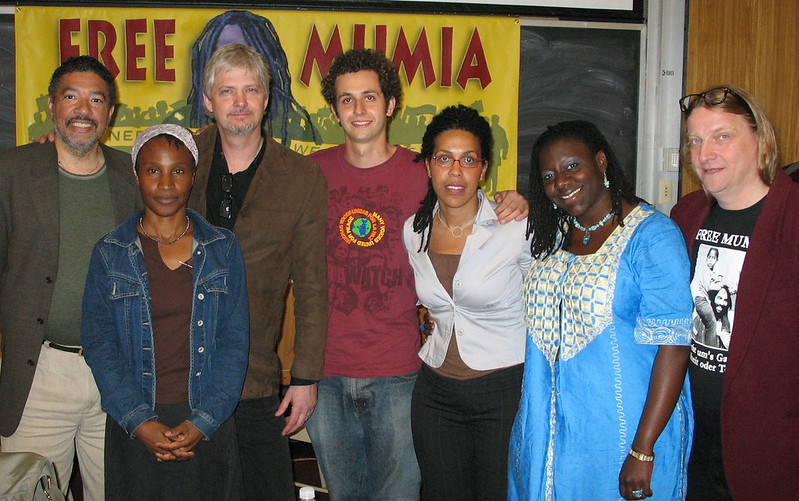
(The Drexel University panel, May 16, 2007. Left to right: Lynn Washington, Joy James, Mark Taylor, Drexel student liaison, Johanna Fernández, Tameka Cage–Conley, Michael Schiffmann. Photo by Joe Piette).
How many press releases did I co-write with Johanna? How many times did we go to work over the phone, often pushing against and navigating between our teaching and publishing duties, to get those press releases or other movement essays, written just right and by deadline?
She had both a revolutionary impatience and a revolutionary patience. Both were gifts. I recall the impatience that she could express in the heat of a chaotic planning meeting—maybe in New York, in Philadelphia, in Princeton—“Guys, we gotta get focused now!” Her patience was expressed in the steady return to details that she showed when planning an event. Perhaps her patience was especially evident in the meticulous care she gave to her book, The Young Lords: A Radical History. For that volume she had to nurture a lawsuit over years against the NYPD, as well as draft and redraft chapters for what became a stellar, award-winning book, recognized for its brilliance and research by the best of historians nearly everywhere, but especially by the most radical ones among them. She also edited an invaluable collection of Mumia’s essays: Writing on the Wall: Selected Prison Writings of Mumia Abu-Jamal.
There are too many stories to tell, too many events to recall along the way of Johanna’s essential contribution to our struggle for Mumia. But consider these: (1) her contributions to EMAJ’s planning and hosting of the Constitution Center event of some 1800 attendees for Mumia in 2011, which occurred just before Mumia left death row; (2) the archiving of Mumia’s papers at Brown University library; (3) her efforts with Mumia to facilitate our movement’s self-critical analysis of potential abusive practices in our own activist communities; and especially (4) her constant presence to Mumia, mobilizing with others as Mumia battled for his health, his very life, against hepatitis B, his heart ailment, and the prison’s medical neglect that worsened all of these. Several times a week, for years, she was on the phone with Mumia, checking on him, visiting with him. I heard from Mumia so many times how important her phone and personal visits with him were.
Johanna’s smartphone also made possible Mumia’s call-ins to my classes. The last call-in she facilitated occurred while she was picking up her lunch at a NYC deli (!). As she told me later, she had received the call from Mumia at a cashier’s counter, then quickly patched Mumia through to my cell phone in Princeton, so that 40 students in my class on incarceration and police repression could have an insightful 15-minute question and answer session with Mumia. This call from Mumia via NYC occurred in the final course I taught before retiring from Princeton Theological Seminary, in Spring 2025.
One last word: Johanna was an internationalist. She wrote for Al-Jazeera and other world publications. Her organizing took her several times to France and Germany where Mumia groups were active. She hosted French and German activists in her NYC apartment. She put hours into laboring with others for the UN and other international bodies seeking justice and freedom for Mumia. She also knew and cultivated the Caribbean radical traditions, which she knew viscerally from her own family’s roots in the Dominican Republic. She rigorously honed her socialist commitments and analyses in a world of imperialism, and also white and masculinist supremacy. We talked often about the importance of Latin America and its liberation theologies for the Mumia struggle. She traveled with a U.S. Prisoner, Labor and Academic Delegation to Palestine in 2016. That delegation, and the declaration it released later, aided reflection on my own travels there in 2007 and more recently in 2025.
Near the time of my retirement from teaching in 2025, I lost track of all that Johanna was doing. She was in the whirlwind of organizing ‘til nearly the end. And when her illness came, we could see how she battled to keep organizing, but also how she had to step back to tend to her health. Phone calls and texts became less frequent.
Back in January of this year, 2026, my text to her about an event being planned ended by my saying, “I hope you’re doing okay, warm regards.” She replied “aww thanks. I am on the mend.” In May I wrote, “It’s been a while. I hope you are okay. Let me know if there’s a good time to call.” And just a few weeks ago, on July 18, I see my last message to her: “Sending you all revolutionary love, respect and power—wherever you are. All prayers and energies to you! -Mark”
There were no replies to these last two texts. In this hard time of loss I am holding on, desperately, to my belief that Johanna, now with the ancestors, will not lose touch with our movement and with each of us. I know that I—along with so many others—will still be hearing her voice as it inspires us with her undying presence for all our struggles to come.
¡Presente! indeed, Johanna Fernández—comrade, professor, friend!